New WildPosh study presents an oral toxicology test for hoverflies
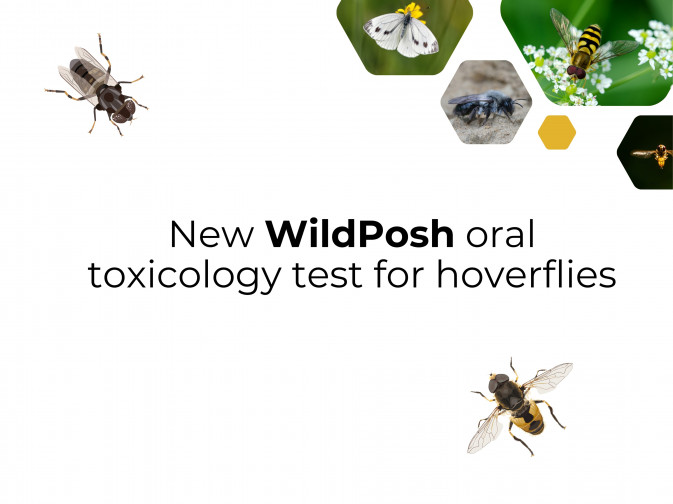
WildPosh partners from the University of Novi Sad, the University of Freiburg, and the University of Gothenburg recently presented a new oral toxicity test for the hoverfly species Eristalinus aeneus. Their study, titled Experimental protocol for acute oral toxicity testing in the hoverfly Eristalinus aeneus (Scopoli, 1763) (Diptera, Syrphidae), was published in the Bulletin of Insectology.
Hoverflies are among the most important non-bee pollinators, and many species also contribute to natural pest control. Like other pollinating insects, they are increasingly exposed to environmental stressors - especially pesticides - which threaten their populations. Yet, unlike for honeybees, and more recently, bumblebees and solitary bees, toxicological research on hoverflies remains limited, and no regulatory testing protocols have been established. In particular, there is still no standardised method for oral toxicity testing in adult hoverflies.
The study addresses this gap by developing a simple and reproducible acute oral toxicity bioassay for Eristalinus aeneus, a species selected for its wide distribution, strong pollination efficiency, and suitability for laboratory rearing. The researchers compared different feeding designs - both with and without artificial flowers - to identify which design produced the highest feeding rates under individual feeding conditions. They also evaluated whether group feeding increased feeding success. Dimethoate, a standard positive control in toxicity studies, was used to validate test sensitivity.
To enable reliable feeding, the research team tested 2D and 3D artificial flowers made from paper petals and compared them to petal-free designs. Although feeding success was generally higher with artificial flowers compared to petal-free designs, no major differences were found between the specific flower models. The highest feeding rate (85%) occurred with the 3D flower featuring downward-sloping petals.
Individual feeding was tested first because it allows precise measurement of the ingested dose, which is critical for toxicity calculations. However, it was deemed unsuccessful due to low feeding success and issues such as evaporation or crystallisation of the test solution. Switching to group feeding resolved these problems and significantly improved feeding reliability.
Despite some limitations, the group feeding offers a practical and reproducible method for oral toxicity testing in E. aeneus and may apply to other hoverfly species. The findings also suggest that E. aeneus is slightly more sensitive to pesticides than Apis mellifera, highlighting the importance of broadening toxicological assessments beyond honeybees.
The authors conclude that group feeding combined with an artificial flower design provides a reliable testing method for hoverflies. Given their ecological importance, further research is needed to map their sensitivity to pesticides and better understand their exposure pathways.